
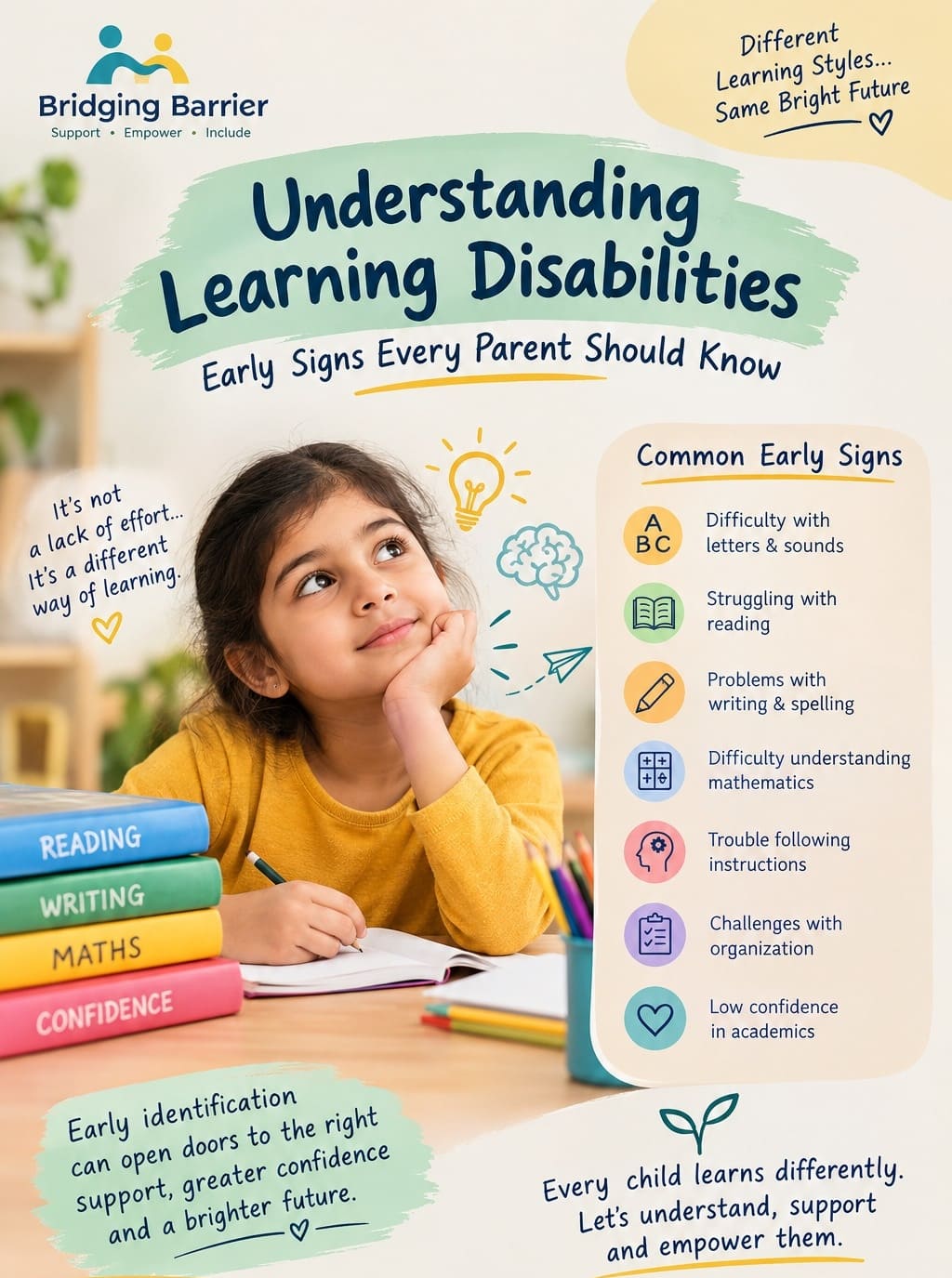
Some children quickly understand numbers, while others may find mathematics challenging. Some children enjoy reading, while others struggle to recognize letters, understand words, or express their thoughts through writing.
These differences do not necessarily mean that a child is less intelligent or less capable. Sometimes, persistent difficulties with reading, writing, mathematics, communication, attention, or learning may indicate a learning disability. Recognizing these signs early can help parents and educators understand what a child needs and provide appropriate support.
What Are Learning Disabilities?
Learning disabilities are difficulties that can affect how a child receives, processes, stores, or uses information. They may influence reading, writing, spelling, mathematics, memory, attention, language processing, following instructions, and organizing tasks. A child with a learning disability can have average or above-average intelligence. The challenge may be related to how the brain processes certain types of information, rather than the child's willingness or ability to learn.
7 Early Signs Parents Should Watch For
1. Difficulty Learning Letters and Sounds
A child may repeatedly struggle to recognize letters, connect letters with sounds, or remember basic phonics concepts.
2. Struggling With Reading
Some children may read much more slowly than their peers, skip or repeat words, or find it difficult to understand what they have read.
3. Problems With Writing and Spelling
Children may struggle with forming letters, spacing, organizing written work, spelling, or expressing ideas in writing.
4. Difficulty Understanding Mathematics
Persistent difficulty with numbers, mathematical symbols, sequences, or basic calculations may need closer attention.
5. Difficulty Following Instructions
A child may have trouble remembering or completing instructions, especially when several steps are given at once.
6. Difficulty With Organization
Some children frequently forget school materials, lose notebooks, miss deadlines, or struggle to plan homework.
7. Low Confidence Around Academics
Repeated academic struggles can affect self-esteem, motivation, and confidence.
Why Early Identification Matters
Early identification does not mean labeling a child. Instead, it helps parents and professionals understand how the child learns and where support may be needed. With appropriate assessment and intervention, children can learn strategies that make academic tasks more manageable. Early support can also help reduce academic frustration, fear of failure, loss of confidence, avoidance of schoolwork, and negative self-perception.
What Can Parents Do?
- Observe: Notice when and where the difficulty occurs.
- Communicate: Speak with teachers and professionals involved in the child's education.
- Seek Professional Guidance: A qualified professional can help understand individual learning needs.
- Create a Supportive Environment: Celebrate effort and progress rather than focusing only on mistakes.
- Give the Child Time: Learning does not happen at the same pace for everyone.
Every Child Has Potential
A learning difficulty does not define a child's intelligence, personality, or future. Children may have different strengths that are not always visible through conventional academic performance. With understanding, appropriate support, patience, and encouragement, children can develop effective learning strategies and greater confidence. At Bridging Barrier, the focus is on understanding the individual needs of every child and creating supportive pathways that help children move forward with confidence.
Frequently Asked Questions
Conclusion
- Understanding is the first step toward support.
- Instead of asking, “Why can't my child learn?”, we can ask: “How does my child learn best?”
- That small change in perspective can make a meaningful difference.
- Bridging Barrier — Supporting every child's journey toward learning, growth, and confidence.