
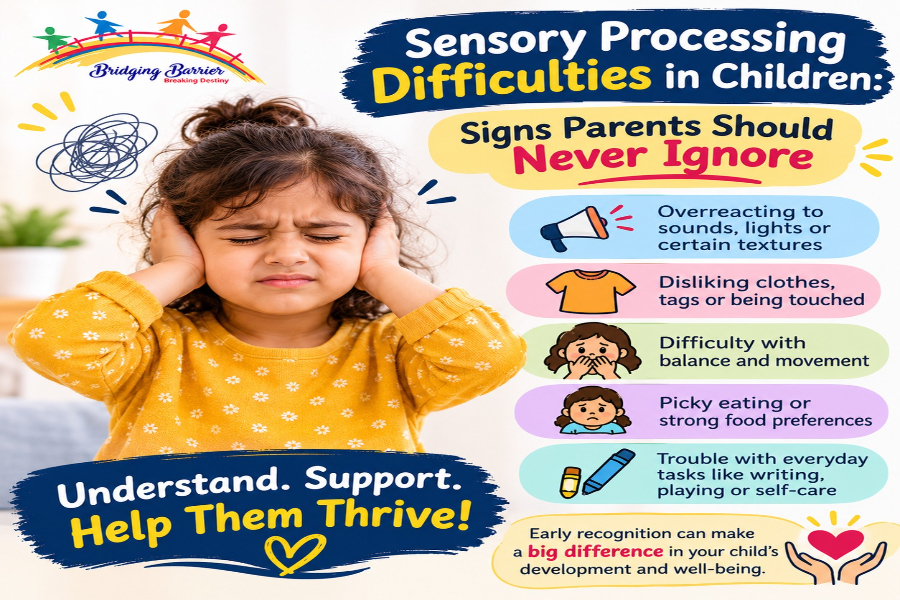
Sensory Processing Difficulties in Children:Signs Parents Should Never Ignore
Your toddler screams every time the vacuum cleaner starts, even from another room. Yoursix-year-old tears the tags out of every shirt and will only wear one pair of soft leggings.Your preschooler crashes into furniture, chews on everything and never seems to tire ofspinning. Your eight-year-old covers their ears in the school canteen and then melts downthe moment they get home. It is easy to read these moments as "fussiness," "attention-seeking" or "bad behaviour."But for many children, they are signs that the brain is having a hard time organising theinformation that arrives from the senses. Understanding this can transform a householdfull of daily battles into one built on empathy and practical support.
What Is Sensory Processing?
Sensory processing is the way the nervous system receives messages from the sensesand turns them into responses. Every second, your child's brain is sorting through a floodof information: the hum of the fridge, the feel of a sock seam, the smell of lunch cooking,the sight of other children moving around the room. Most brains filter, prioritise andrespond without any conscious effort. In a child with sensory processing difficulties, that filtering system works differently.Some sensations feel too loud, too bright or too intense. Others barely register at all. Andsometimes the brain struggles to combine information from several senses at once.
It's more than five senses
Most of us learn about sight, hearing, taste, smell and touch. Occupational therapists alsotalk about three less familiar senses that matter just as much for everyday life:
- Vestibular sense: the sense of movement, balance and head position, located in theinner ear. It tells us whether we are upright, spinning or falling.
- Proprioception: the sense of where our body is in space and how much force ourmuscles are using. It lets us climb stairs without looking at our feet or hold a pencil without snapping it.
- Interoception:the sense of what is happening inside the body, such as hunger, thirst,needing the toilet, a racing heart or feeling tired.
Difficulties can show up in any one of these, or in several together.
A Note on Terminology
You may see the terms Sensory Processing Disorder (SPD),sensory integrationdysfunction or simply sensory processing differences. It is worth knowing that SPD is notcurrently listed as a separate diagnosis in the major diagnostic manuals (the DSM-5 orICD-11), and professionals continue to debate how best to define it. However, sensorydifferences are formally recognised as part of the diagnostic criteria for autism, and theyare very common in ADHD, developmental coordination disorder (dyspraxia), anxiety andother developmental conditions. What matters for parents is this: whether or not the label appears in a manual, thedifficulties are real, they can affect daily life significantly, and occupational therapistshave well-established ways to assess and support them.
The Three Main Patterns
Sensory difficulties tend to fall into broad patterns. A child may show one pattern, a mix ofthem, or different patterns for different senses.
1. Over-responsiveness (sensory avoiding)
The child's nervous system reacts too strongly or too quickly to input. Ordinarysensations can feel uncomfortable, overwhelming or even painful.
- Covers ears or becomes distressed at everyday noises such as hand dryers, blenders,sirens or crowds
- Dislikes certain clothing textures, seams, tags or wet clothes
- Refuses many foods because of texture, temperature or smell
- Resists hair brushing, nail cutting, tooth brushing or face washing
- Avoids messy play such as sand, paint, glue or mud
- Dislikes being touched unexpectedly, or flinches at light touch
- Becomes anxious on swings, slides or when feet leave the ground
2. Under-responsiveness (low registration)
The child's nervous system doesn't notice input as readily as it should. These children canlook "in their own world" or unusually calm, and may miss cues others pick up easily.
- Doesn't seem to notice when their name is called
- Seems unaware of pain, extreme temperatures, or a messy face or runny nose
- Is slow to react to touch, noise or other stimuli
- May appear lethargic or hard to engage
3. Sensory seeking
The child craves more input than usual and goes looking for it, often in ways that look likehyperactivity or "bad behaviour."
- Constantly moving, spinning, jumping, crashing or climbing
- Chews clothing, pencils or toys
- Touches everything and everyone, sometimes too hard or too close
- Loves intense movement and may have no sense of danger
- Seeks loud noises, strong flavours or tight squeezes and bear hugs
- Has trouble sitting still, especially in a classroom
Sensory discrimination and motor difficulties
Some children struggle with discrimination : telling the difference between sensations,such as feeling what an object is without looking, or working out where a sound is comingfrom. Others have difficulty with sensory-based motor skills , which can look likeclumsiness, poor balance, trouble with handwriting or difficulty learning new physicaltasks.
Signs Parents Should Never Ignore
Every child has sensory preferences. Plenty of toddlers dislike loud noises or fuss aboutsocks. What makes a pattern worth paying attention to is that it is intense, persistent andgetting in the way of daily life . These are the signs that deserve a conversation with aprofessional.
In babies and toddlers (0 to 3 years)
- Extreme distress during routine care such as bathing, nappy changes or hair washing
- Stiffening, arching or crying when held or cuddled, or the opposite: seeming floppyand unresponsive
- Very limited diet with strong gagging at new textures well beyond the usual fussyphase
- Frequent, intense meltdowns triggered by sound, light or touch
- Constantly moving or, conversely, showing very little interest in exploring
- Delayed motor milestones, or unusual fear of movement, or no fear of heights at all
- Poor sleep that is difficult to settle, along with strong reactions to lights, sounds or bedding
In preschool and school-age children (3 to 12 years)
- Daily battles over clothing, to the point that dressing takes an hour or causes tears
- Extremely restricted eating, accepting only a handful of foods
- Avoiding playgrounds, group activities or school events because of noise or crowds
- Repeated meltdowns after school, often called "after-school restraint collapse," whena child holds it together all day and falls apart at home
- Severe distress over haircuts, tooth brushing, showers or nail trimming
- Clumsiness, frequent falls or bumping into things, and difficulty with ball skills orbicycles
- Constant fidgeting, chewing, or crashing that disrupts learning
- Poor handwriting or difficulty copying from the board despite good intelligence
- Seeming not to feel pain, or not noticing when hurt
- Trouble with toileting, such as not recognising the need to go, linked to interoceptiondifferences
In older children and teenagers
- Withdrawing from social situations because of noise, smells or crowds
- Anxiety or irritability that rises sharply in busy environments
- Difficulty with personal care such as showering or brushing teeth because ofsensation
- Extreme sensitivity to clothing or food that limits daily choices
- Sensory Processing Diffi culties in Children: Signs Parents Should Never Ignore
- Exhaustion after school or social activities
- Seeking intense stimulation, or taking unsafe physical risks
Red flags that call for prompt attention
Speak to your paediatrician soon if sensory difficulties come with any of the following:
- Loss of skills your child previously had, such as speech or social interaction
- Very limited eating causing weight loss, nutritional concerns or frequent choking andgagging
- Self-injurious behaviour such as head banging or biting that causes harm
- Severe, frequent meltdowns that are dangerous or unmanageable
- Marked delays in speech, language or social engagement
- Signs of ongoing anxiety, school refusal or a significant drop in mood
Why Does This Happen?
Researchers are still working to understand the causes. Current evidence suggests thatsensory processing differences have a neurological basis and can run in families.Premature birth, prenatal factors and other developmental conditions are associated withhigher rates. Importantly, sensory processing difficulties are not caused by bad parenting , too much screen time or a lack of discipline, though environments can makesymptoms better or worse.
How Sensory Differences Show Up as "Behaviour"
One of the most important ideas for parents is that behaviour is communication . A childwho looks defiant may be overwhelmed. A child who appears inattentive may be filteringout too much, or too little. Consider how common behaviours might look from the inside:
| What you see | What your child may be experiencing |
|---|---|
| Refuses to wear a coat or shoes | Seams, textures or tightness feel painful orunbearable |
| Has a meltdown in the supermarket | Fluorescent lights, noise, smells and movement areoverwhelming |
| Won't sit still at the table | Their body needs movement to stay regulated andfocused |
| Gags at mealtimes | Texture or smell triggers a strong physical reaction |
| Hits or pushes friends during play | Difficulty judging force, or seeking intense touchinput |
| Hides from hugs | Light or unexpected touch can feel threatening |
| Doesn't respond to instructions | Struggling to filter background noise, or lowregistration of sound |
Asking "What is my child's body telling me?" instead of "Why won't they behave?" is oftenthe single most powerful shift a family can make.
The Link With Other Conditions
Sensory processing differences often appear alongside other conditions:
- Autism: sensory differences are very common and are part of the diagnostic criteria.
- ADHD: many children with ADHD have sensory sensitivities or sensory-seekingbehaviour, and the two can be hard to tell apart.
- Developmental coordination disorder (dyspraxia): motor planning and sensoryprocessing are closely connected.
- Anxiety: a nervous system on constant high alert can make sensory experiences feelworse, and sensory overload can in turn fuel anxiety.
- Giftedness and learning differences: some children who are intellectually strong stillstruggle with sensory regulation.
Because these conditions overlap, a thorough assessment matters. Treating "just thebehaviour" without understanding the cause rarely works.
Getting an Assessment
If you recognise your child in this guide, a good starting point is:
- 1.Your paediatrician or family doctorThey can rule out hearing, vision and medicalissues, such as ear infections or reflux, and refer you on.
- 2.An occupational therapist (OT),ideally one with training in sensory integration. OTsare the main professionals who assess sensory processing, usually through parentquestionnaires, structured observation and play-based activities.
- 3.Other specialists as needed,such as a speech and language therapist, feedingspecialist, psychologist or developmental paediatrician, particularly if autism, ADHDor anxiety is suspected.
Before the appointment, it helps to keep a simple diary for a week or two. Note whattriggers your child's reactions, how long they last, what helps, and how it affects meals,sleep, school and family life. Short phone videos of typical situations can be very helpful,too.
Support and Therapy
Occupational therapy and sensory integration
OT is the most commonly recommended approach. Sessions are play-based and tailoredto the child. A therapist may use swings, climbing equipment, textured materials andgames that gradually help the nervous system respond more comfortably. Therapists alsocoach parents and teachers on strategies for everyday life. Research on the effectivenessof sensory-based approaches is still developing, with some studies showing promisingresults for particular approaches, so it is worth choosing a qualified therapist who setsclear, measurable goals with you.
A "sensory diet"
Despite the name, a sensory diet has nothing to do with food. It is a personalised scheduleof sensory activities spread through the day that helps a child stay regulated. Examplesinclude:
- Calming input: deep pressure hugs, weighted lap pads (used under professionalguidance), slow rocking, quiet corners, dim lighting
- Alerting input: crunchy or chewy snacks, cold water, jumping or bouncing, upbeatmusic
- Organising input (heavy work): pushing a laundry basket, carrying groceries, wallpush-ups, animal walks, climbing, helping with gardening
A therapist can help you work out which activities suit your child, and when to use them.
Feeding support
For children with severe food selectivity, specialist feeding therapy works gently andgradually, often by building comfort with a food through play, smell and touch beforeexpecting any eating. Pressure to "just try it" usually backfires.
Working on emotional regulation
Older children can benefit from learning to recognise their own early warning signs, suchas a racing heart, tight muscles or irritability, and what to do about them. Psychologistsand OTs often work together on this.
Practical Strategies at Home
These ideas are general, so adapt them to your child's own profile.
Create a sensory-friendly space
- Set up a calm corner with soft cushions, a blanket and low light where your child canretreat without any shame or punishment.
- Reduce clutter, strong smells and background noise at home where possible.
- Offer noise-reducing headphones for loud places, and sunglasses or a cap for brightenvironments.
Make everyday routines easier
- Clothing: choose soft, seamless fabrics, remove tags, wear socks inside out if seamsbother them, and let your child help choose clothes. Keep a few "safe" outfits inrotation.
- Hair and teeth: try a soft brush, warm water, unscented products, or let the child takethe lead. A firm, predictable touch is often easier to tolerate than a light touch.
- Meals: serve familiar foods alongside new ones without pressure, keep mealtimescalm, and avoid forcing or bribing.
- Bedtime: a consistent routine, heavy blankets (only if age-appropriate andrecommended by a professional, and never for babies or toddlers), blackout curtainsand white noise can help.
Prepare for transitions and new places
- Give advance warning: "We're going to the shop. It will be bright and noisy. We'll beback in ten minutes."
- Use visual schedules and countdown timers.
- Visit new places at quiet times first.
- Bring a comfort kit: headphones, a fidget, a favourite snack and water.
Respond to meltdowns with calm
A meltdown is not a tantrum. It is a nervous system in overload, and your child can'treason their way out of it.
- Stay calm and keep your voice low and your words few.
- Reduce the input: move somewhere quieter, dim the lights, give space.
- Wait until your child is calm before talking about what happened.
- Afterwards, think about what the triggers were and how to prevent them next time.
Build in movement
Daily physical play such as swimming, trampolining, climbing, cycling and playground timegives vestibular and proprioceptive input that many children crave and need.
Supporting Your Child at School
School can be one of the most challenging sensory environments: fluorescent lights,scraping chairs, echoing halls, crowded lunchrooms, hand dryers and unpredictabletransitions. Working with teachers makes a big difference. Helpful accommodationsinclude:
- Seating away from doors, windows and noisy equipment
- A wobble cushion, standing desk or permission to stand or move while working
- Regular movement breaks and "heavy work" jobs such as carrying books or wipingboards
- Fidget tools or chewelry for children who need oral input
- Access to a quiet space or a calm-down card
- Ear defenders for assemblies, fire drills and noisy classes
- Early warning of schedule changes or fire drills
- Alternatives to messy or uncomfortable activities
- Flexibility with uniforms, where possible
- Understanding that a child who is holding it together all day may fall apart at home
Share your OT's report with the school, ask for a meeting, and request that supports arewritten into a formal plan, such as an individualised education or support plan, where thisis available in your area.
Myths and Misunderstandings
"They're just spoiled or picky." Sensory difficulties are neurological, not a failure ofdiscipline. Punishment does not teach a nervous system to feel differently.
"They'll grow out of it." Some children improve as their brains mature and with support,but many continue to have sensory differences into adulthood. Early help teaches skillsthat last.
"If I give in, I'm making it worse." Respecting a genuine sensory need is not spoiling.Accommodating while gradually and gently building tolerance is very different fromforcing exposure.
"Only autistic children have sensory issues." Sensory differences are very common inautism, but plenty of non-autistic children have them too.
"It's all about being over-sensitive." Many children are under-responsive or sensoryseeking, and these patterns are often mistaken for hyperactivity or inattention.
"A weighted blanket or gadget will fix it." Tools can help some children, but they are not acure and should be used with professional guidance and with attention to safety.
Looking After Yourself
Living with a child whose senses are easily overwhelmed can be exhausting. You may feeljudged in supermarkets, or avoid social events, or feel guilty about every meltdown. A fewreminders:
- You are not failing. You are parenting a child with specific needs.
- Find other parents, either online or locally, who truly understand.
- Share what you learn with grandparents, partners and carers so everyone respondsconsistently.
- Ask for help, including counselling, if you are struggling.
Seeing the Strengths
Sensory sensitivity has another side. Many children with these differences notice detailsothers miss, are deeply attuned to music, art, nature and texture, show remarkableempathy and creativity, and experience joy intensely. Part of supporting your child ishelping them understand their senses as part of who they are, and giving them the toolsto feel safe and comfortable in the world.
Final Thoughts
The signs of sensory processing difficulties are easy to miss, and even easier to misreadas defiance. But when we look more closely, a different story often emerges: a child who isworking very hard to cope with a world that feels too loud, too bright, too close or too fast,or too quiet and far away. If something in this guide feels familiar, trust your instincts. Talk to your paediatrician,seek an occupational therapy assessment, and begin making small changes at home andat school. With understanding, patience and the right support, children learn to makesense of their senses, and families find that daily life can become calmer, happier andmore connected.
Disclaimer: This article is for general information and education only and is not a substitutefor professional medical, psychological or therapeutic advice. If you have concerns aboutyour child's development or wellbeing, please consult a qualified healthcare professional.