
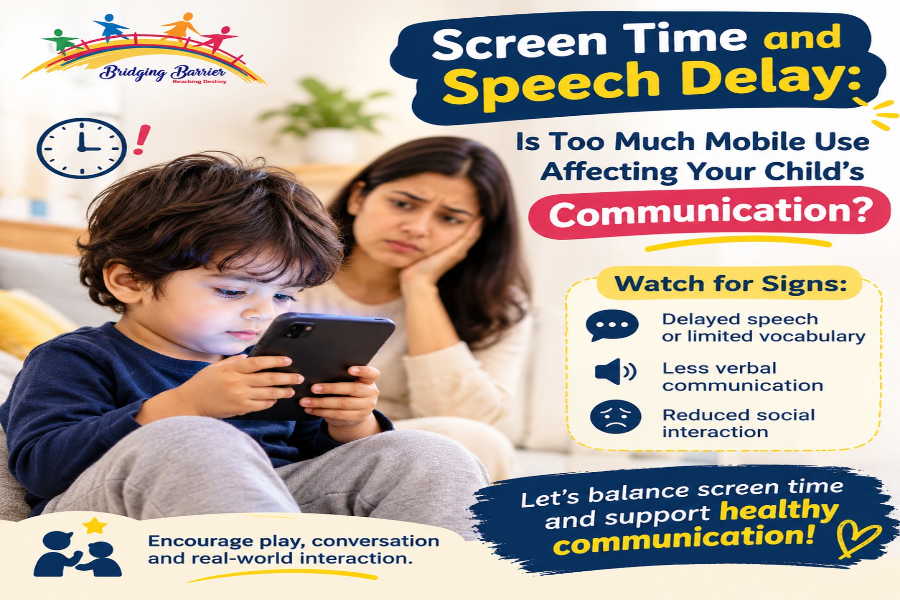
Screen Time and Speech Delay: Is Too Much Mobile Use Affecting Your Child's Communication?
It is a scene in millions of homes. A toddler is fussing at the dinner table, a parent hands over a phone, and within seconds there is quiet. A cartoon plays, the food gets eaten, and everyone breathes out. Most of us have been there, and it is nothing to feel ashamed about. But a worry is growing among parents, paediatricians and speech-language therapists alike: is all this screen time quietly affecting how our children learn to talk? The honest answer is nuanced. Screens are not poison, and a speech delay is rarely caused by one single thing. Yet the research, and what therapists see in their clinics, points to a real pattern worth taking seriously. This guide walks through what we know, what we don't, and what you can do starting today.
How children actually learn to speak
Children do not learn to talk by simply hearing words. They learn through back-and-forth interaction, often called "serve and return." A baby babbles, a parent responds. A toddler points at a dog, a parent says, "Yes! A big brown dog!" The child watches your mouth, reads your face, hears your tone, and tries again. This kind of live, responsive exchange:
- Teaches vocabulary in a meaningful context
- Builds turn-taking, the foundation of conversation
- Trains the child to read facial expressions and gestures
- Strengthens the emotional bond that motivates a child to communicate at all
A screen, however colourful or educational, cannot truly do this. It talks at a child, not with them. It does not pause, notice confusion, or adjust to what the child just said.
What the research says
Several studies have explored the link between early screen exposure and language development. While most show association rather than proof of cause, the findings are consistent enough to take seriously:
- Language delay and early screen use.A widely cited 2020 Canadian study in JAMA Pediatrics found that more screen time at age one was associated with poorer results on developmental screening at ages two and four, including communication.
- Fewer words spoken at home.Research by Dr. Dimitri Christakis and colleagues, using audio recordings of children's homes, found that when a TV was on, children heard fewer adult words and took fewer conversational turns.
- Background TV counts too.Even when a child is not watching, a TV running in the background can interrupt play and reduce the quality of parent-child talk.
- Brain structure.Imaging research in preschoolers has linked high screen use with differences in brain areas related to language and literacy, though scientists stress this is an early finding.
It is important to be fair here. Correlation is not causation. Children who watch more screens may also have fewer chances to talk, fewer books at home, or busier, more stressed parents. Screen time is probably one piece of a bigger picture, not a lone villain. But it is a piece that parents can change.
Why screens may get in the way
- 1. Screens replace conversation. Every hour with a screen is an hour not spent in chatter, play, songs, or storytime.
- 2. Passive watching is not learning. Toddlers learn far less from a video than from the same lesson delivered by a real person, known as the "video deficit effect."
- 3. Fast-paced content overwhelms. Rapid scene changes, flashing colours and loud sounds hold attention, but give a young brain little time to process language.
- 4. Screens disrupt play. Pretend play, building, and messy sensory play are where children practise words, ideas and storytelling.
- 5. Parents get distracted too. When adults are on their own phones, they talk to their children less and respond more slowly. Therapists sometimes call this "technoference."
Signs of a possible speech or language delay
Every child develops at their own pace, so a late talker is not automatically a child with a problem. Still, these general markers are worth knowing:
| Age | What you would typically expect |
|---|---|
| 12 Months | Babbling, responds to name, uses simple gestures like waving or pointing |
| 18 Months | Says several single words, understands simple instructions |
| 24 Months | Uses roughly 50 or more words, starts joining two words together ("more milk") |
| 3 Years | Speaks in short sentences, strangers can understand much of what they say |
| 4 Years | Tells simple stories, asks lots of questions, speech is mostly clear |
Consider seeking an evaluation if your child:
- Does not babble or use gestures by around 12 months
- Has very few words by 18 months
- Does not combine words by 2 years
- Doesn't respond when you call their name
- Seems to lose words or skills they once had
- Avoids eye contact or shows little interest in interacting with people
- Is hard to understand at 3 years or older
A loss of previously learned skills, or very limited eye contact and social engagement, should be raised with a doctor promptly. These can point to conditions beyond a simple language delay, including hearing difficulties or developmental differences, and early support makes a real difference.
What the guidelines recommend
- Under 18 to 24 months: Avoid screens other than video calls with family (American Academy of Pediatrics).
- Ages 2 to 5: Keep screen time limited: the World Health Organization advises no more than about one hour a day, and less is better.
- At any age: Choose high-quality content, watch together when possible, and keep screens out of mealtimes and bedtimes.
These are guidelines, not rules to be broken by guilt. If your child has had more screen time than recommended, the goal is not to panic. It is to gently shift the balance.
Practical steps you can take today
- 1. Make mealtimes screen-free Meals are naturally rich in conversation. If a phone has become the only way to get food into your child, start small: one meal a day without a screen.
- 2. Narrate your day Talk about what you are doing, even if your child cannot answer yet. "Now we are washing the carrots. Splash, splash! The water is cold."
- 3. Follow your child's lead If they point at a ball and say "ba," you say, "Yes, ball! A red ball. Roll the ball!"
- 4. Read together every day Books expose children to richer vocabulary than everyday speech. Reading in your home language is just as valuable, and a multilingual home is not a cause of speech delay.
- 5. Sing songs and rhymes Nursery rhymes, lullabies and clapping games teach rhythm, sounds and memory, and make language fun.
- 6. Replace, don't just remove Keep a few options ready: building blocks, crayons, a kitchen play set, water play, a walk outside, or ten minutes of your full attention.
- 7. Choose better content, and watch together Pick slow-paced, age-appropriate programmes and ask questions: "What is the bunny doing? Where did the ball go?"
- 8. Turn off the background noise If nobody is watching the TV, switch it off. It reduces how much you talk and how well your child can focus.
- 9. Model the habit Putting your own phone away during playtime, meals and bedtime does more than any rule you set for them.
- 10. Don't use screens as the default soother Screens can help on a hard day. The concern is when they become the main way a child calms down, leaving fewer chances to learn other ways to cope and communicate.
What if my child is already showing delays?
First, take a breath. Speech delays are common, and many children catch up, especially with early support.
- Step 1: Check hearing. Ear infections or hearing loss can cause delays and are easy to miss.
- Step 2: See your paediatrician. Share your concerns and ask for a developmental screening.
- Step 3: Consult a speech-language pathologist. They can assess your child and give tailored strategies for home. Parents are the most important part of therapy.
- Step 4: Reduce screen time gradually. Many parents notice improvements in eye contact, attention and speech after cutting back and increasing interactive play. Every child is different, and reducing screens is not a replacement for professional help when a delay is present.
Please avoid blaming yourself. Modern parenting is demanding, and screens are everywhere. What matters is the direction you move in from here.
Common myths, cleared up
- "Educational apps will make my child talk earlier." For toddlers, live interaction teaches language far better than apps or videos. Nothing beats a responsive person.
- "My child can sing the whole alphabet song from a video, so they're fine." Repeating songs is different from using language to communicate. Look at whether your child can request, comment, answer and play with others.
- "Boys always talk late." Boys are on average slightly later than girls, but that is no reason to delay advice if you are worried.
- "Screens are the only cause of speech delay." No. Hearing problems, genetics, developmental conditions and many other factors play a role. Screens are one modifiable influence among many.
A balanced way forward
This is not about banning technology or labelling parents as failures. Video calls with grandparents, a carefully chosen show, or a few minutes of screen time while you cook dinner are part of real life. The real question is balance: is my child getting enough face-to-face talk, play, books, music and movement? If screens are crowding those out, that is the signal to adjust.
A simple self-check:
- Does my child have plenty of back-and-forth conversation every day?
- Are mealtimes, bedtime and car rides mostly screen-free?
- Do I know what my child is watching, and do I sometimes watch with them?
- Am I giving my child my full attention for part of every day?
If you answered "no" to a few of these, small changes can go a long way.
Key takeaways
- Children learn language through live, responsive interaction, not passive watching.
- Research links heavy early screen use with poorer language outcomes, though it shows association rather than proof of cause.
- Screens can reduce talk time, disrupt play and distract parents, all of which matter for speech.
- Know the developmental milestones, and seek an evaluation early if you're concerned.
- Simple habits such as screen-free meals, daily reading, narration and play make a big difference.
- Early help works. If you are worried, speak to your paediatrician or a speech therapist rather than waiting.